BS1 - Breadboard Synthesizer
Maxwell Beck a rédigé la version originale en anglais de ce billet.
Elle est disponible ici sur son blog .
Bien que je me concentre principalement sur l’aspect logiciel des ordinateurs, j’ai toujours eu un intérêt pour le génie électrique. Ainsi, après avoir été épuisé par certains projets de programmation, j'ai décidé d'essayer quelque chose d'un peu différent et de construire une sorte de circuit électronique. Je me suis inspiré de tous les ordinateurs que les gens ont construits, principalement inspirés par Ben Eater, mais j'ai décidé d'adopter une approche différente et j'ai plutôt construit un synthétiseur analogique sur des planches à pain.
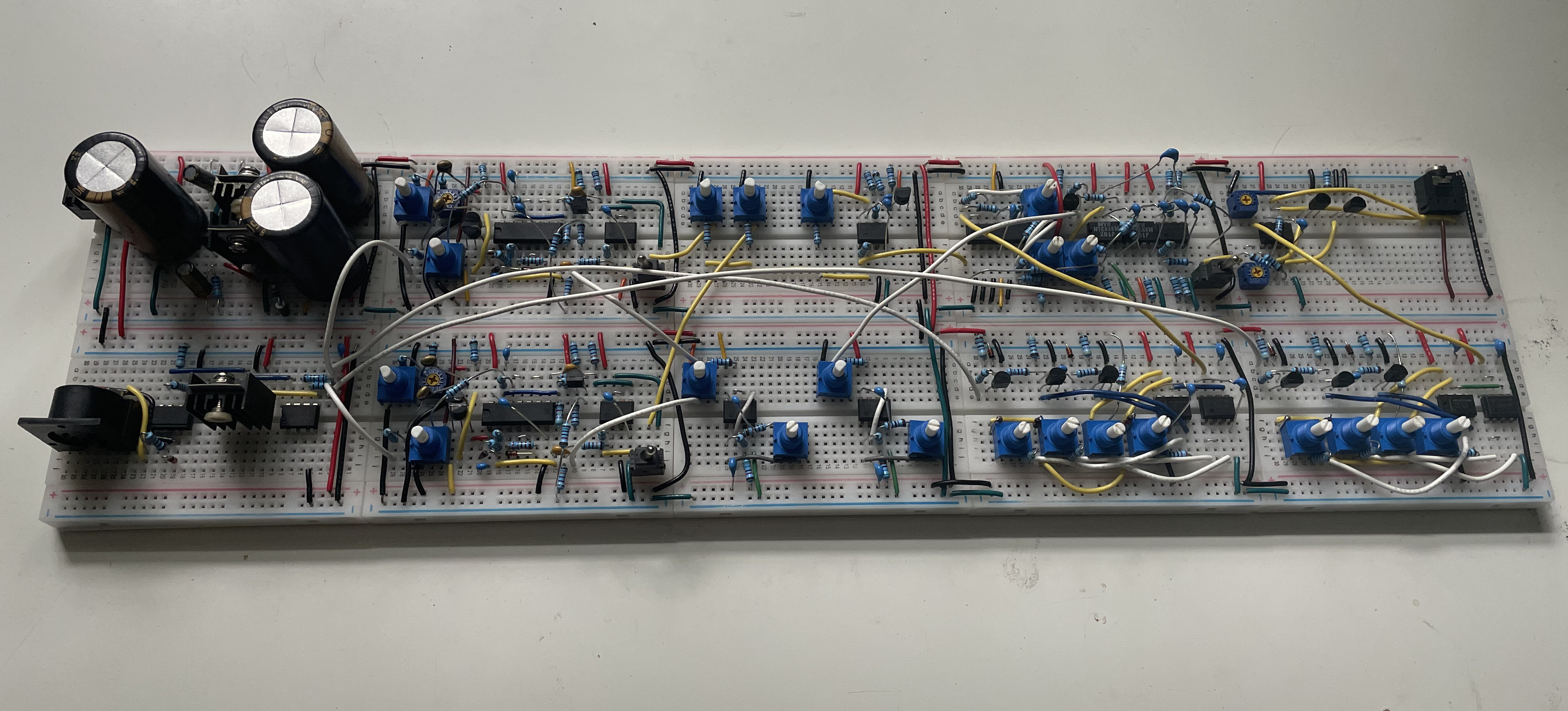
Voici BS-1, mon synthétiseur sur plaques d'essai. Il comprend une alimentation double rail, un convertisseur MIDI vers CV, deux oscillateurs, deux LFO, une source de bruit, un mélangeur, un clone Polivoks VCF, deux ADSR et un VCA. Comme je ne suis en aucun cas un expert en électronique analogique, aucune de ces conceptions n’est originale et ont plutôt été tirées de divers endroits sur Internet. Cependant, je souhaite écrire cet article pour expliquer comment j'ai sélectionné les conceptions et comment le processus de construction s'est déroulé dans son ensemble.
Table of Contents
Rules of the Game
Avant de commencer à définir les conceptions pour les composants, j'ai établi deux règles simples pour m'aider à affiner les choses :
- Pas de puces qui font tout pour moi (par exemple CEM3340)
- Chaque module doit tenir sur une plaque d'essai standard à 400 terminaux
Je ne voulais pas que le projet soit trop simple, mais je ne voulais pas non plus passer 12 heures d'affilée à construire un filtre. Ces règles m’ont aidé à atteindre cet objectif.
VCOs
Pour les oscillateurs, j'ai choisi le design VCO 4069 de René Schmitz :
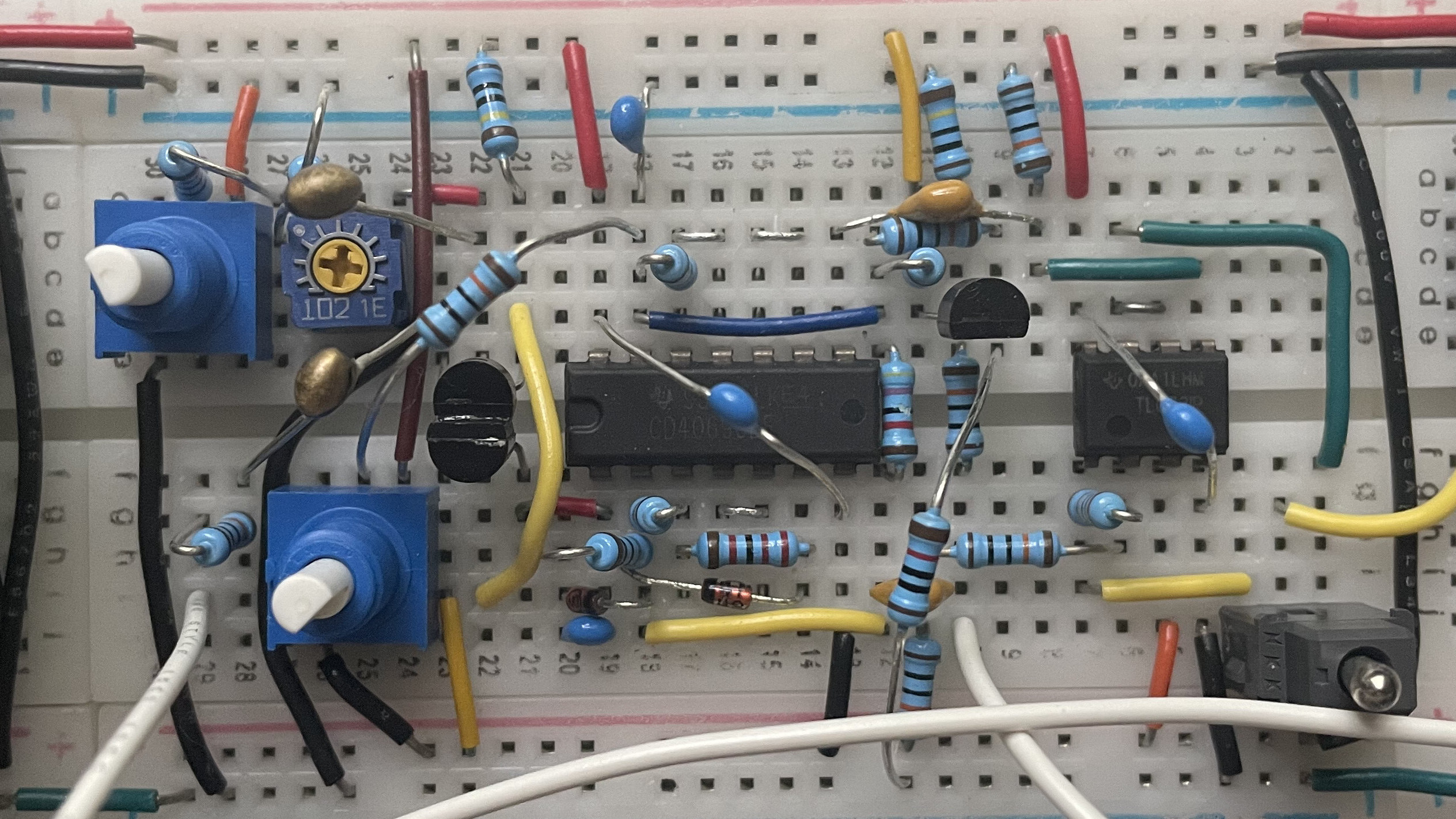
Une conception géniale basée sur l'inverseur sextuple CMOS 4069. Il fournit à la fois un signal de sortie en dents de scie ("Saw" en anglais) et en Modulation de Largeur d’Impulsion ("MLI" ou Pulse Width Modulation,"PWM" en anglais).
- Raisonnement
J'ai été vraiment attiré par l'utilisation d'une puce inverseuse pour créer un oscillateur, car pour quelqu'un comme moi qui est relativement débutant en électronique analogique, cela semble tellement ésotérique. En général, je m'attendrais à ce qu'un onduleur soit utilisé dans un circuit numérique, pas un générateur de forme d'onde analogique ! J'ai aussi aimé la simplicité du circuit, car de cette façon il s'adapterait à la seule planche à pain sur laquelle je le voulais. Enfin, le PWM était une exigence pour moi, j'étais donc heureux de découvrir que des circuits simples comme celui-ci pouvaient le fournir.
- Notes de construction
Installer ce circuit sur la planche à pain unique était un peu délicat, en particulier la partie d'onde de scie à noyau, que vous pouvez voir sur la face inférieure du 4069. Plus ennuyeux, cependant, j'ai rencontré un problème où le circuit générait une sorte de bourdonnement sur les rails d'alimentation. Après avoir construit le VCF, j'ai découvert que même avec l'oscillateur complètement détaché, un bourdonnement entrait toujours dans le filtre. J'ai fini par résoudre ce problème en touchant des parties aléatoires du circuit avec ma pince, découvrant finalement que lorsque je touchais la broche 13 du 4069, le bourdonnement disparaissait. Sachant que mes pinces introduisaient une sorte de capacité, j'ai mis un petit condensateur céramique entre la broche 13 et la masse, et le bourdonnement a disparu. Si quelqu'un pouvait réellement expliquer ce qui s'est passé, je l'apprécierais certainement !
- Mises en garde
J'ai trouvé que le contrôle MLI était un peu étrange, et 50 % sur le potentiomètre ne correspond pas réellement à 50 % de largeur d'impulsion. Étant donné que j’ai construit ce circuit deux fois, je ne pense pas avoir commis d’erreur de construction, et je suppose que c’est comme ça.
LFOs
Pour obtenir un peu de modulation, j'ai construit deux LFO simples de relaxation d'ampli opérationnel ou Op-Amp :
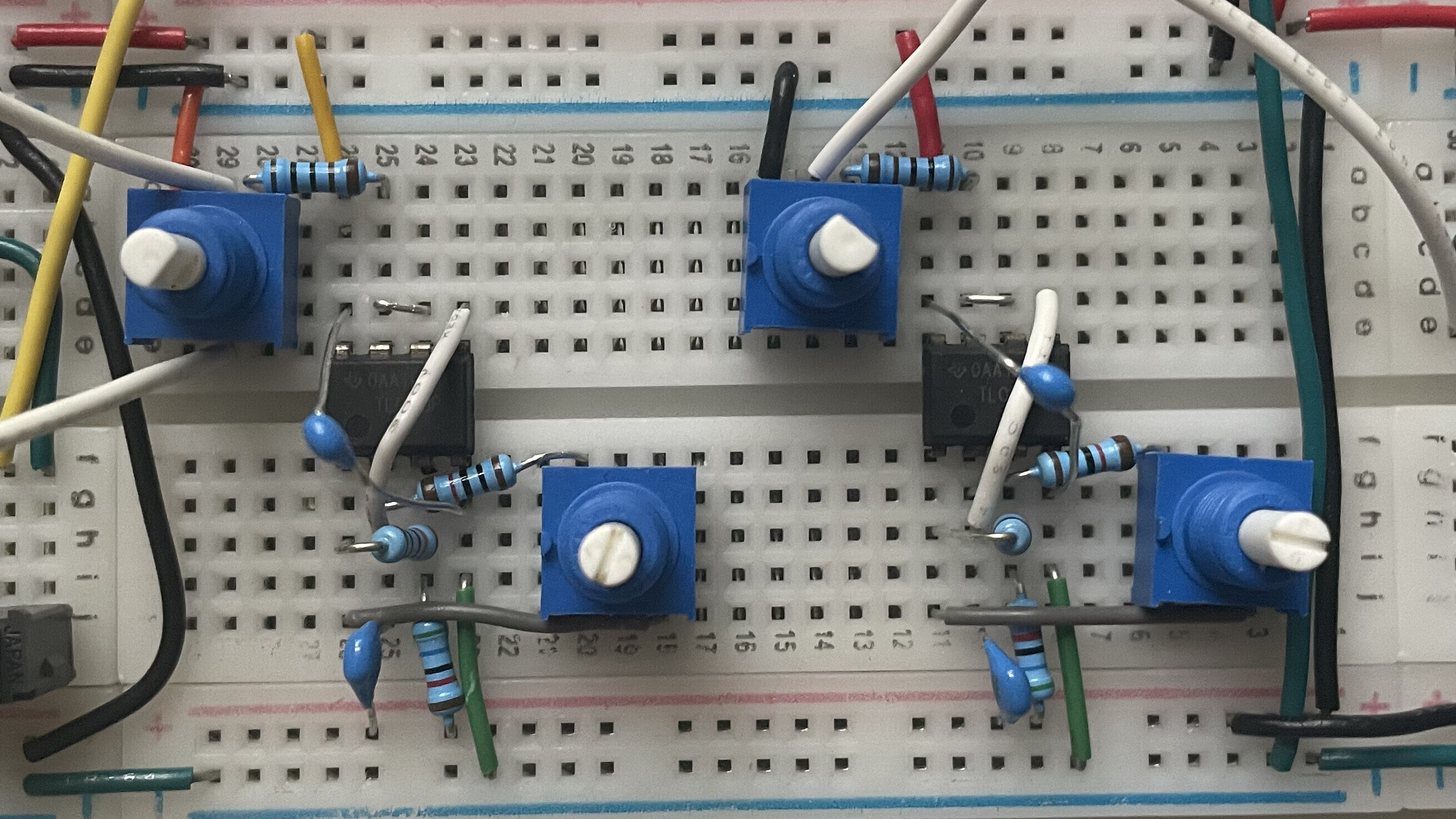
These are hardwired to the PWM input of each oscillator and the filter cutoff. Not much to say about these since it is such a simple circuit. I cannot even remember the exact website I got it off of as it is so ubiquitous.
Mixer + Noise Source
Another simple circuit: just a 3-channel summing mixer with a transistor breakdown white noise source:
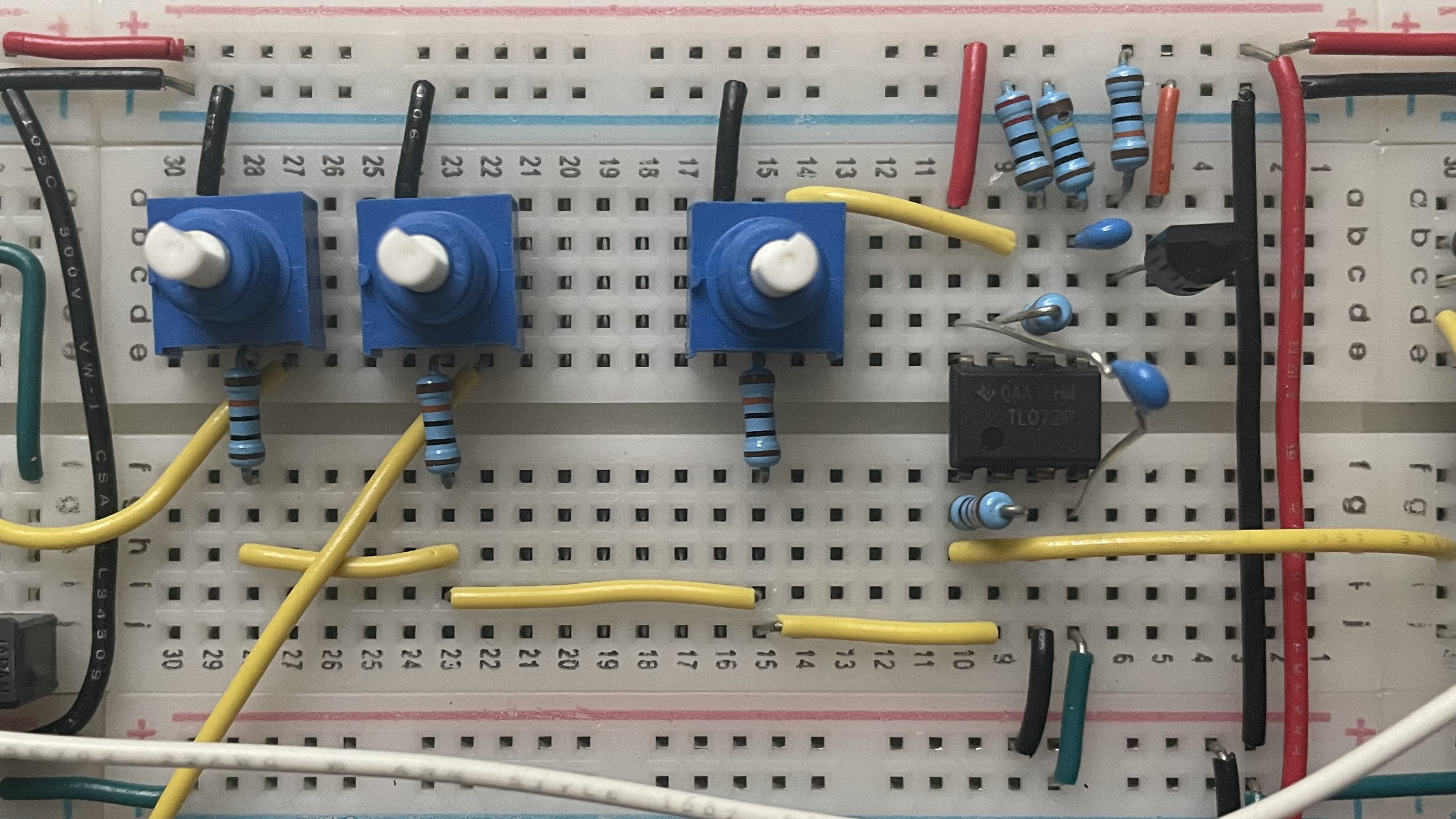
This mixes together both of the oscillators and adds a little texture with the white noise before going off to the VCF.
- Construction Notes
The transistor noise was actually a little tricky to nail down. Most example schematics for the most minimal design use a common emitter amplifier to bring up the noise. However, I wanted to use an op-amp so that I could use a dual op-amp chip and combine it with the mixer. While making an amplifier with an op-amp is easy, it took me a while to realize that I needed to amplify way more than I thought I would have to. I forget what gain I ultimately set it to, but it is still too low, and at this point I am too lazy to fix it. Not sure if that issue comes down to not using the right value resistor on the transistor, or if I really just need to set the gain higher.
VCF
Here is the real star of the show, the Polivoks VCF clone:
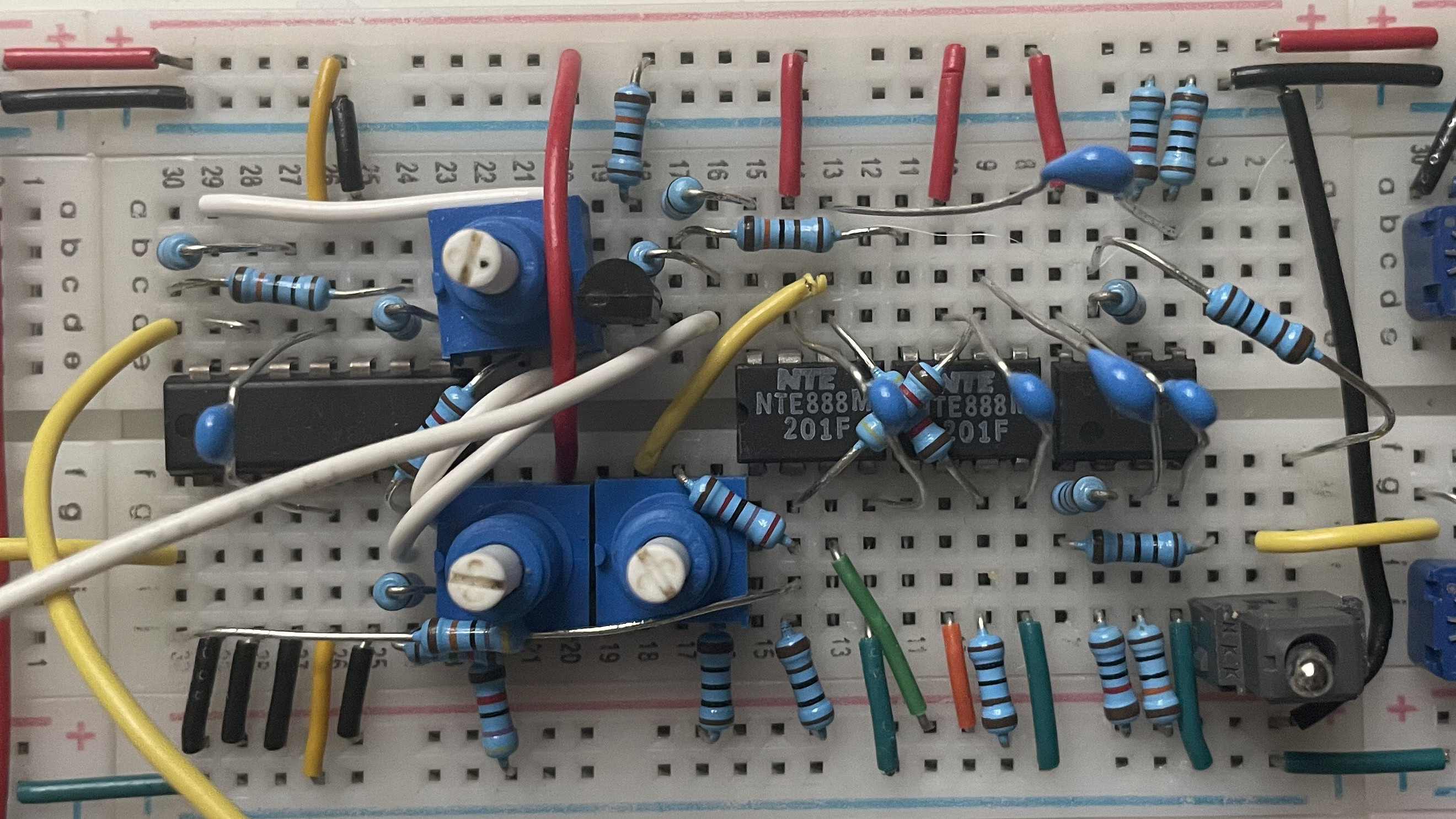
This design comes from Dave Brown, which in turn is a modified version of Marc Bareille’s design, using NTE888M op-amps as a replacement for the original Soviet ones.
- Rationale
Picking out a VCF was really hard. Most people seem to either recommend a full-on Moog filter or the absolute bare minimum op-amp thingy. However, I wanted something between those two. After looking all over the place, I came across this genius design. Ordering the NTE888Ms was a bit annoying, but in the end it was worth it.
- Construction Notes
I ended up cutting out a couple features from the design due to limited space on the breadboard. First off, I removed the 1V/oct FM input, which I did not really mind that much since I did not intend to patch pitch CV into the filter anyway. Secondly, I had to remove the switch between hard and soft clipping in the filter, which is a bit of a shame when doing self-oscillation. It would be nice to have a less aggressive mode, but I guess that could come in a future synthesizer.
ADSRs
I built two ADSR envelope generators using René Schmitz’s Fastest ADSR in the West design:
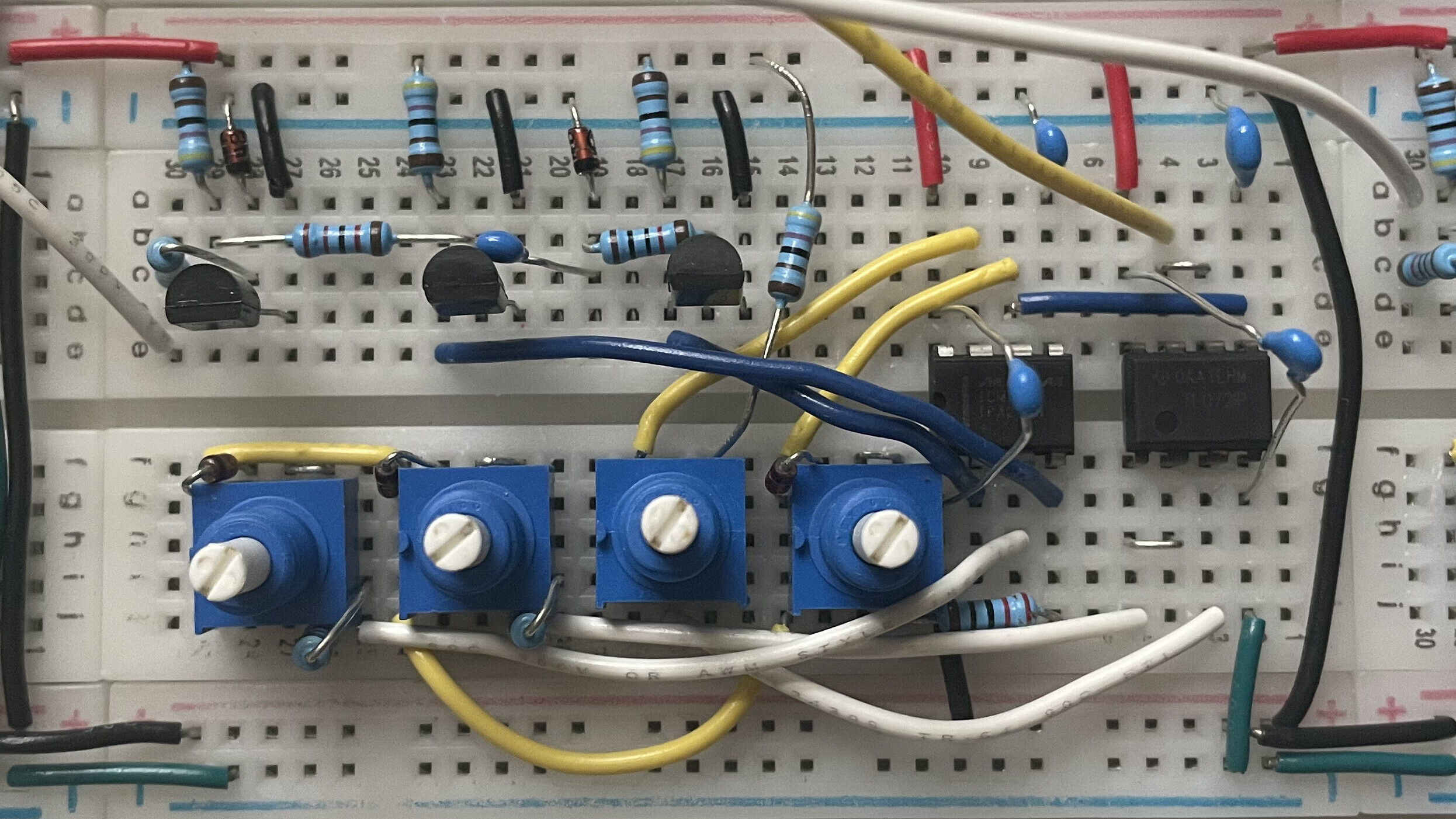
One is wired to the cutoff of the VCF, and the other is wired to the amplitude of the VCA.
- Construction Notes
Squeezing these onto the breadboards was extremely difficult. While the circuit to generate the trigger pulse breadboarded very well, the rest was a total mess. It took two tries to really get it right, as on the first try, diodes were crossing everywhere, nearly shorting out. Luckily, I was able to figure out a much better layout, and now it is fairly neat.
- Caveats
For some reason, even with the release set all the way down, the output does not fully shut off, and instead gets very low and then tapers off towards zero very slowly. This could be a construction error, as I had a bit of a hard time reading the capacitor values in the hand-drawn schematic. However, it could also just be a flaw of the design.
VCA
To complete the main signal chain, we have a VCA using Henry Santana’s dual JFET design:
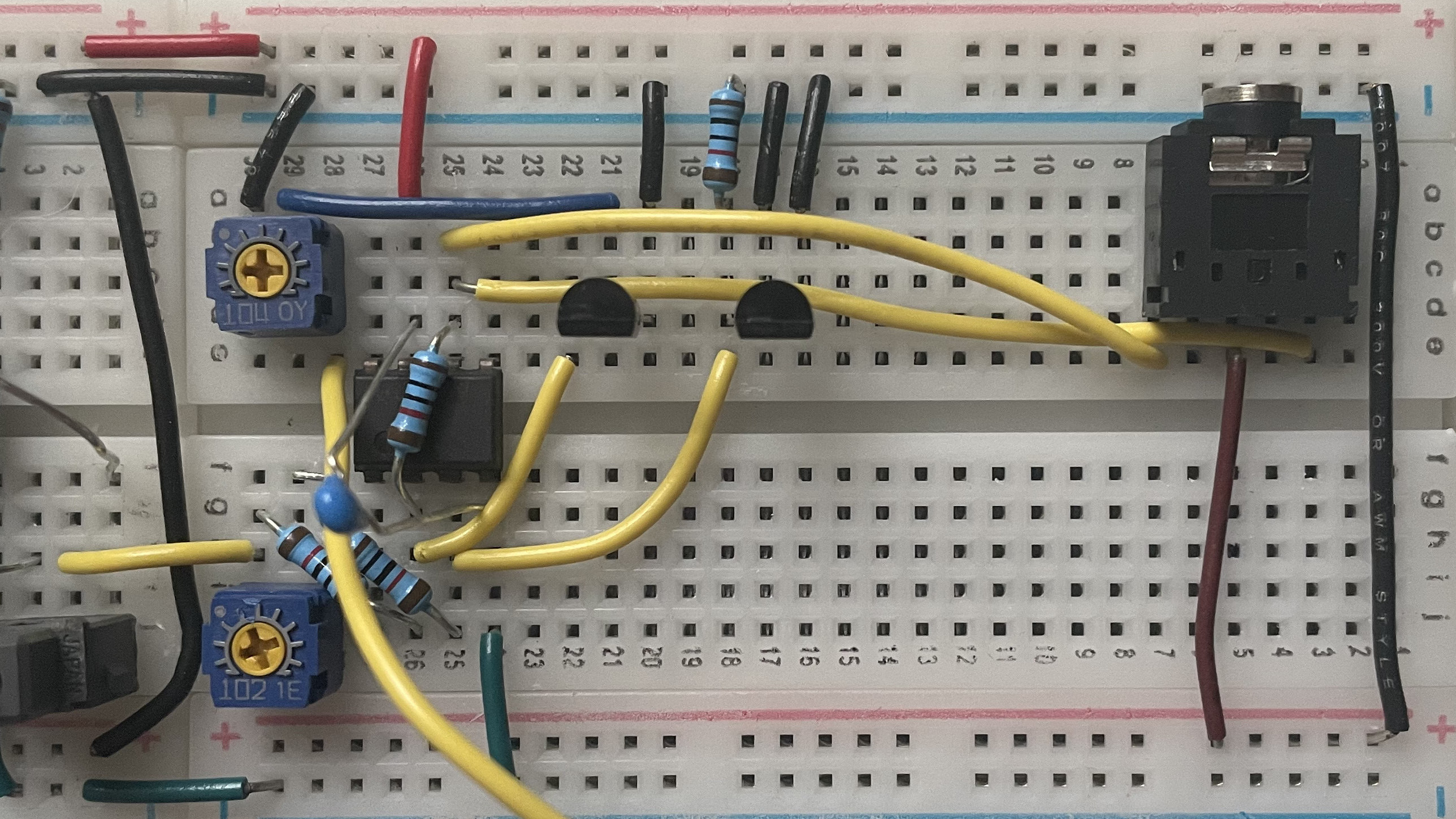
Originally published in Electronic Design Magazine, this design is about as simple as it gets, requiring only two JFETs, an op-amp, and a couple resistors.
- Rationale
Most people online seem to recommend using a VCA chip such as the THAT2180, but would go against my rules for the project. It took a lot of searching, but I eventually came across this design, which performs amazingly well for how simple it is. It does require matched JFETs, but unlike what some people seem to claim, they do not need to be perfectly matched, and slight differences can be accounted for with a trimpot.
The Rest
Lastly, there are two more components that I have not touched on yet: the power supply and the MIDI-to-CV converter. The power supply is the Goldpoint VG-1 circuit, featuring some massive capacitors for smoothing. The MIDI-to-CV converter is based around Jan Ostman’s Good Ol’ MIDI to CV project. I made some slight modifications to the code as it handles stacked notes really strangely by default. For now I am going to leave those modifications private out of sheer laziness, but if anyone wants to see them, feel free to reach out and I can publish them.
Demo Video
Here is a quick video showing off some features of BS-1:
Conclusion
In the end, I could not be happier with how this project turned out and how much I learned from it. I honestly did not expect to even be able to make it this far, as I have nearly no background in analog electronics. Though most of the project was glueing together existing designs, it still took a lot of effort and research to figure out which designs to use, how exactly to combine them, and how to modify them to fit my goals. I am thinking about how I could build another synthesizer, though I have no idea what it would look like yet. Maybe something more Buchla inspired? As a final note, I will be releasing a full song made exclusively with BS-1 at Flashparty 2021. After that, the song will be available for download on my Bandcamp.